
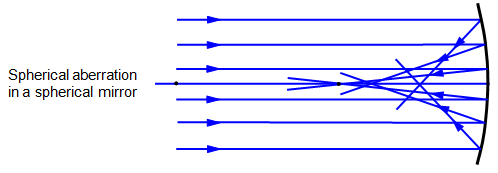
The problem with spherical mirrors is that rays at different distances from the principal axis of the mirror are not all brought to a focus at the same distance from the main mirror. The ones furthest from the centre being focussed closer to the mirror than those at the centre. This defect is called spherical aberration. (See following diagram). It is for this reason that parabolic mirrors are used where all the rays are brought to a focus at one point.
However there is another solution to the difficulty, this is known as a Schmidt telescope. In a Schmidt telescope the problem is solved by using an ordinary spherical mirror but putting a correcting plate at the front end of the telescope tube. This correcting plate is like a large lens but with a complex design – it is convex in the centre and concave towards the edges. This changes the direction of the incoming rays and means that the rays far from the axis do not converge so quickly and so all rays are brought to a focus at one point.
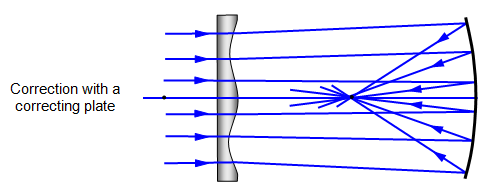
To
make the effect more obvious the spreading of the light due to the plate and the curvature of
the correcting plate has been exaggerated a little.
The correcting plate is usually a
bit smaller than the main mirror to allow for the divergence of the light.
One problem
with the Schmidt telescope experienced by amateur astronomers is that on cold night dew
forms on the correcting plate. To prevent this a 'dew shield', just an extension to the main
telescope tube, is put round the front of the telescope. This is sometimes heated although in
most cases a cardboard tube will be perfectly adequate.
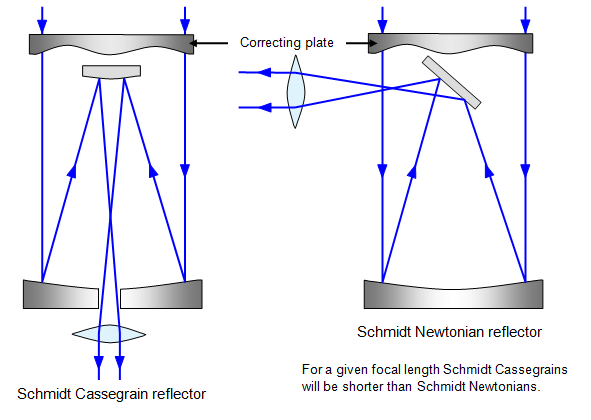
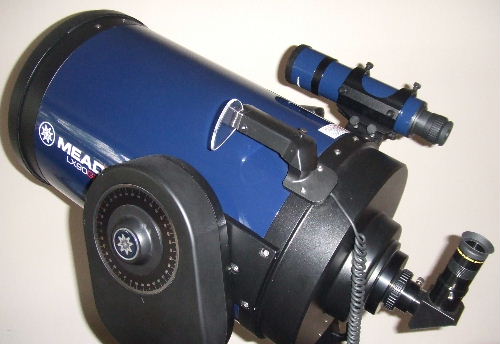
There are two main types
of Schmidt telescope in use; most are Schmidt Cassegrains while some are Schmidt
Newtonians. Examples of both types are shown in the following diagrams.
The diagrams
show the position of the correcting plate although the change in direction of incoming light
has been omitted since it would be too small to be noticeable at this scale. Schmidt
Cassegrain telescopes have become really popular with amateurs because of their relatively
small size for a long focal length. This will give high magnifications with normal eyepieces
although for deep sky work a focal reducer (a lens that shortens the focal length) is
needed.
The two main types of Schmidt telescope.