
The refractive
index (n) of a solid may be found by:
(a) direct measurement of the angles of incidence
and refraction. It can then be calculated from n= sin i/sin r
(b) real depth and apparent
depth measurements. It can be calculated from n = real depth/apparent depth
(See: 11-
14/Light/Experiments/Refraction)
(c) using a prism and spectrometer and the minimum
deviation method
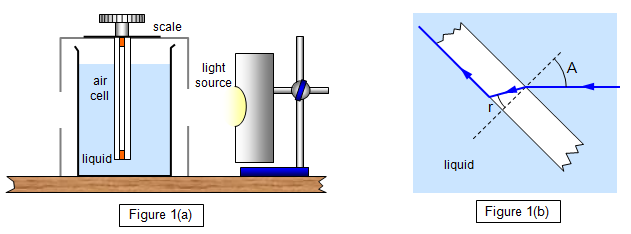
A monochromatic light source is viewed through two slits
placed either side of the container, and the air cell rotated until no light passes through the
apparatus. A reading is taken of the orientation of the air cell at this position. The air cell is
now rotated past the straight-through position until the light is cut out again. The angle of
rotation from one position to the other is found (Figure 1(b)).
The light does not pass
through the air cell because it is totally internally reflected when it travels from the first glass
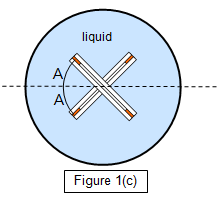
plate towards the air gap. Figure 1(c) shows the conditions that apply when the light is just
cut off.
At this point:
nLsinA = ngsinr = nasin90 =
na and so the refractive index of the liquid is given by:
Refractive index of
liquid (nL) = na/sin A = 1/sinA
where A is half the angle through
which the air cell is turned between cut-off positions.
Notice that the refractive index
of the glass is not required.
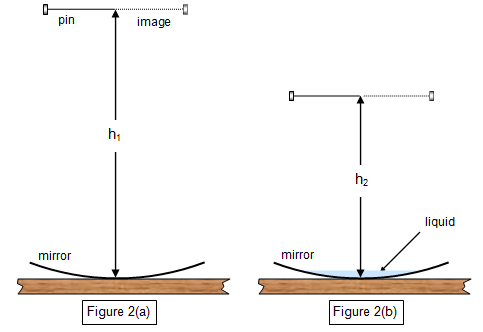
A pin is held vertically above a concave mirror and its position
adjusted until there is no parallax between the object and image (Figure 2(a). The distance
from the mirror to the pin is then measured (h1). A small quantity of liquid is placed
on the mirror and the procedure repeated giving a new, smaller distance (h2) (Figure
2(b)).
It can be shown that the refractive index nL of the liquid is given
by
Refractive index of liquid (nL) =
h1/h2