Proof of Bernoulli's theorem
Consider a fluid of negligible viscosity
moving with laminar flow, as shown in Figure 1.
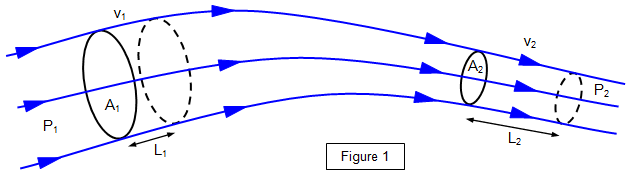
Let the velocity, pressure and area of the
fluid column be v
1, P
1 and A
1 at Q and v
2, P
2 and
A
2 at R. Let the volume bounded by Q and R move to S and T where QS =
L
1, and RT = L
2. If the fluid is incompressible:
A
1L
1
= A
2L
2The work done by the pressure difference per unit volume =
gain in k.e. per unit volume + gain in p.e. per unit volume. Now:
Work done = force x
distance = p x volume
Net work done per unit volume = P
1 - P
2 k.e.
per unit volume = ½ mv
2 = ½ Vρ v
2 = ½ρv
2 (V = 1 for unit
volume)
Therefore:
k.e. gained per unit volume = ½ ρ(v
22 - v
12)
p.e. gained per unit volume = ρg(h
2 – h
1)
where h
1 and h
2 are the heights of Q
and R above some reference level. Therefore:
P
1 - P
2 = ½ ρ(v
12 – v
22) + ρg(h
2 - h
1)
P
1 +
½ ρv
12 + ρgh
1 = P
2 + ½ ρv
22 +
rgh
2Therefore:
P + ½ ρv2 + ρgh is a constant
For a horizontal tube h
1 =
h
2 and so we have:
P + ½ ρv2 = a constant
This is Bernoulli's theorem You can see that
if there is a increase in velocity there must be a decrease of pressure and vice versa.
No
fluid is totally incompressible but in practice the general qualitative assumptions still hold for
real fluids.
A VERSION IN WORD IS AVAILABLE ON THE SCHOOLPHYSICS USB