Measurement of the viscosity of glycerol
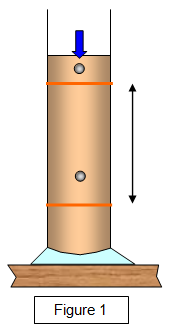
The viscosity of a liquid can easily be measured in the laboratory with the
apparatus shown in Figure 1.
A one-litre measuring cylinder is filled with glycerol and two rubber
bands are placed around it a known distance apart (say 20 cm). The diameter of a small steel
ball bearing is measured with a micrometer and it is then released from just above the glycerol
surface and allowed to fall through the fluid, the time for it to pass from the level of one band to
that of the other being taken.
If the bands are placed sufficiently far from the surface it can be
assumed that the ball bearing has reached its terminal velocity before passing between them.
The velocity of the ball bearing between the bands can then be found, and it is assumed that
this is its terminal velocity. From Stokes' Law the viscosity of the fluid may be found.
Viscosity (η) = 2gr2(ρ - σ)/9v
The
temperature of the glycerol should be recorded and the experiment should be repeated with ball
bearings of different radii.
For accurate work allowance should be made for the effects
of the walls of the container and for this reason the experiment should always be carried out
with cylinders of large radii compared with the ball-bearings.
Golden syrup makes a
cheaper and perfectly suitable substitution for glycerol!

schoolphysics Stokes' Law animation
To see an animation of Stokes' Law click on the animation link.
Example problem
Calculate the terminal velocity of a raindrop of radius 0.2 cm (raindrops with radii much greater than this will become unstable and break up).
(Density of water = 1000 kg m-3 and that of air about 1 kg m-3)
Terminal velocity V =2gr2(r – s)/9h = 2 x 9.81 x (0.2 x 10-2)2 x 999/9 x 10-3
= 7.04 x10⁻²/9x10-3 = 8.7ms-1
We can use Stokes' Law to calculate either
the size of small spherical particles falling through a fluid or the time it will take a particle to fall a
given distance if the radius of the particle is known.
Example problem
Find the time taken for a particle of carbon (density 2300 kg m-3) with a radius of 0.0001 m to fall 2 m through air (viscosity 0.001 Pas).
Terminal velocity = 2 x 10 x 10-10 x 2300/10-2 =4.6 x 10⁻⁴ms-1
Time to fall 2 m = 2/[4.6x10-4] = 4348 s = 72 m = 1.2 hr
A VERSION IN WORD IS AVAILABLE ON THE SCHOOLPHYSICS USB