
All musical instruments rely on the vibration of air to produce a note. The air is usually set in vibration either by a moving string or by the oscillation of air enclosed in a pipe.
Stringed instruments are set in vibration either by a bow (as with a violin or cello),
by a hammer (piano) or by plucking (guitar, harpsichord).
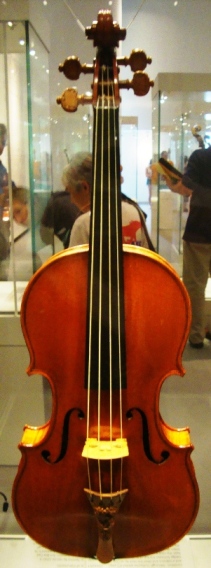
The photograph on the right is of the 'Messiah' Stradivarius violin - reputed to have hardly ever been played since it was made in the early part of the eighteenth century. If it were to be put up for sale the asking price would probably be in the region of £10 million!
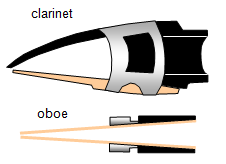
Wind instruments are all basically tubes in which the air is made to vibrate. Woodwind instruments are of two kinds:
 Woodwind
(a)
instruments with reeds such as the clarinet, saxophone and oboe.
(b) instruments where
the passage of air across a hole causes the air in the tube to vibrate such as the flute,
recorder and organ.
 Brass
Brass
In brass instruments the air is vibrated by a
mouthpiece, the tension of the player's lips or the length of the tube altering the pitch of the
note.
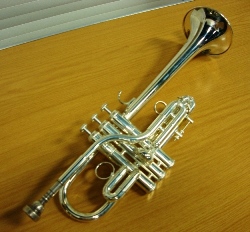
The photograph shows a trumpet which also has valves which enables the length of the tube making the note to be altered. The same method is used in the french horn. In a trombone this is done by moving the slider.
What makes a pleasant musical sound is something that varies from
person to person — some prefer pop and some jazz, while others only listen to Bach! All
types of music are built up from basically the same set of notes, however. So an even more
fundamental thing than the type of music we prefer are the actual frequencies of the notes
that make up what we call a scale.
The situation is complicated by the fact that there
are actually two different scales:
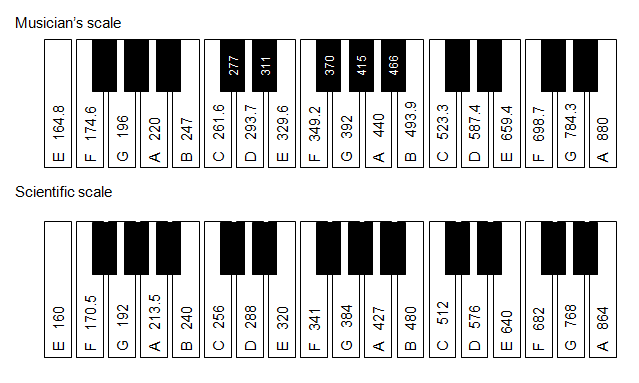
(a) the scientific scale based on middle C having a
frequency of 256 Hz, also known as the diatonic scale, and
(b) the musicians' scale
based on A having a frequency of exactly 440 Hz, also known as the equally tempered scale.
On this scale middle C has a frequency of 261.6 Hz.
The frequency ratio for two
notes one octave apart is 2:1 while for a fifth it is 1.5:1. On the equally tempered scale the
frequency ratio for each semitone is 1.0595:1. The ratio for the tone interval is the sixth root
of 2 and that for the semitone the twelfth root of 2.
The frequency of notes in music
have a precise relationship with each other. It is these ratios between one note's frequency
and the next that makes combinations of notes pleasant to listen to. Notice that if you
increase the pitch by one octave the frequency doubles. Using a 'key note' we can build up
the whole scale.
| Note | C | D | E | F | G | A | B | C' |
| Frequency (Hz) | 256 | 288 | 320 | 341 | 384 | 427 | 480 | 512 |
| Ratio of frequency to that of the keynote |
1 | 9/8 | 5/4 | 34/3 | 3/2 | 5/3 | 15/8 | 2 |