
Tides
The theory of gravitation can be used to explain the tides. The
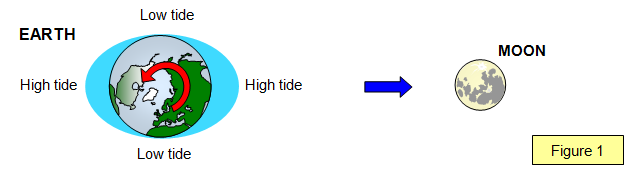
gravitational pull of the Moon is the main reason for the tides on Earth. The Moon attracts
the water in the seas, pulling up a bulge of water towards it. The Earth itself is also attracted
and so another bulge of water is 'left behind' on the opposite side of the Earth from the
Moon. Places on the Earth beneath the two bulges have high tides at that moment while
places at right angles to these have low tides at that moment (see Figure 1).
The Earth rotates
beneath these two bulges and as it does so every place on Earth has two high tides and two
low tides a day (see Figure 1).
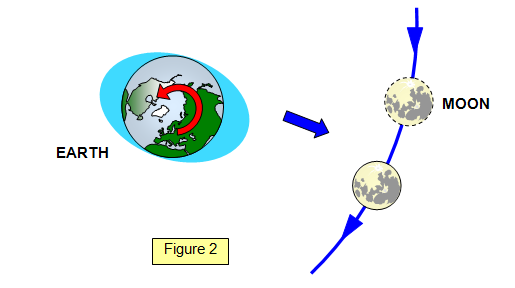
There is not exactly 12 hours between the high tides
at a particular place on the Earth because the Moon is not only pulling on the water but also
moving round the Earth as it does so. As it moves it 'pulls' the bulge of water round with it
(see Figure 2).
The interval between two high tides is a little over eleven hours
because of this.
The height of the tides is also affected by the geography of the
region. For example the Severn estuary in south west England is shaped like a funnel and
so small changes out at sea are magnified as you move east 'towards the narrow end of the
funnel' and so there is a very large difference between high and low water. This results in the
Severn bore, a small wall of water that rushes up the river as the tides turn.
The
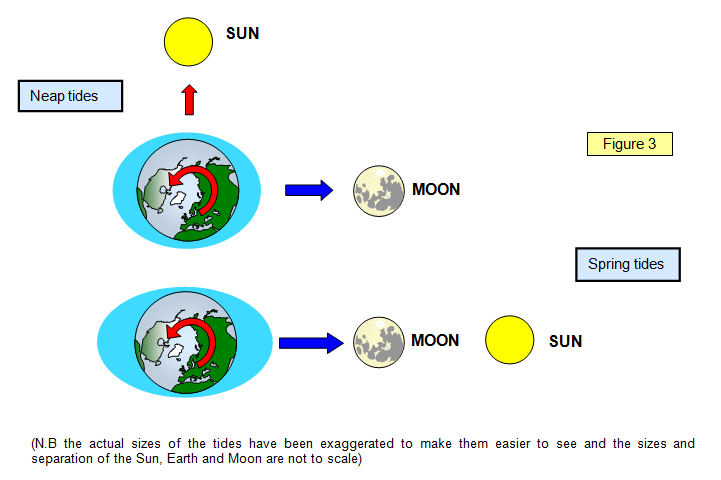
gravitational pull of the Sun also affects the tides and so the height of the tide changes as
we go through the year. This is because of the relative positions of the Sun and Moon (see
Figure 3).
If the Sun is in the same direction as the Moon the pull of the Sun and
Moon are also in the same direction so the total pull is bigger and we get very high and very
low tides. There is a big difference between high and low water. We call these 'Spring' tides
although they may not be in the spring.
The 'opposite' of the Spring tides are the
'Neap' tides. These are tides where the difference between high and low water is not very
great and are produced when the Sun and Moon are pulling on the water at right angles to
each other.

schoolphysics tides animation
To see an animation of the tides click on the animation link.
A VERSION IN WORD IS AVAILABLE ON THE SCHOOLPHYSICS USB