Toys and Physics – Light
4.1 Luminous stars
What happensThese stars are made of a
luminous material. They can be stuck on your bedroom ceiling to make
constellations.
Theory and teaching notesThese are made of a
fluorescent material. Illuminating them with ultra violet light will make them glow all the better
in the dark. (Take sensible precautions if using an ultra violet lamp).
4.2
Kaleidoscope
 What
happens
What
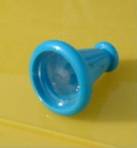
happensWhen you look through the kaleidoscope you see multiple images of the
view.
Theory and teaching notesThere are two sorts of kaleidoscope
– the one shown in the photograph has a face of multiple prisms – giving many images. The
other has two mirrors inclined to each other at a small angle. The multiple images in this
case are formed by multiple reflections in the mirrors.
4.3
Laser
What happensA small spot of light is formed on a
screen
DANGER: BE CAREFUL OF THE BEAM BOTH DIRECTLY AND BY
REFLECTION EVEN FROM A LASER POINTER.
 Theory and teaching
notes
Theory and teaching
notesThe semiconductor laser is sufficient to send a fine beam across the lab. It is
very useful as a demonstration instrument for interference and diffraction.
4.4
Fibre optic lamp
 What happens
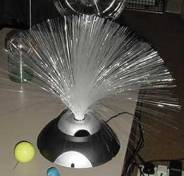
When you switch the lamp on light the ends
of the plastic fibres glow.
Theory and teaching notesThe fibre optics
lamp (or torch) uses a spray of fine plastic fibres to demonstrate the path of light along a fibre
from a central light source. Some versions even have lamps that change colour. (Nothing to
do with fibre optics – just a filter passing over the lamp).
4.5
Lava lamp
What happensWhen the lamp is on large globules of material slowly rise and
fall within the liquid.
Theory and teaching notesWhen the lamp is
switched on the lava lamp heat up. This changes the density of both the liquid and the
material within it. The surface tension of the material makes it form spheres and these move
up and down as their density changes are slightly different form those of the
liquid.
4.6 Sunset
 What happens
A beam of light from a torch or a projector is
shone through a tank of water to which a small amount of milk has been added (For a tank
25cm x 35cm x 40cm you will need about half one of the small containers of milk served with
coffee in a cafe). The water/milk mixture glows blue at the end nearest the projector and this
slowly turns to red further along the tank.
Theory and teaching
notesAs the light passes through the tank it is scattered by the particles of fat in the
milk – the blue light being scattered first. The result is that the water in the end of the tank
nearest the projector looks bluish while that at the other end of the tank has a reddish hue –
just like a sunset.
A few drops of dettol can be used instead of the
milk.
4.7 Glowing putty
 What happens
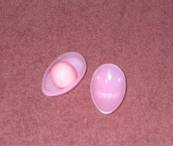
The putty glows in the
dark.
Theory and teaching notesWhen ultra violet light falls on the
putty some of the energy is absorbed and later re-emitted in the visible range. Since the putty
can be made into a ball which also bounces it is great fun to use in a darkened lab. Sunlight
works as a weak source of ultra violet and so there is no need to use an ultra violet
lamp.
4.8 Ball in water
What happensThe clear
plastic ball has a flat coloured picture fixed inside. When you put the ball in water the ball
seems to stay the same size while the picture suspended inside it gets
smaller!
Theory and teaching notesWhen it is immersed in water there
is a concave lens effect since the ball is full of air. The water-plastic-air surface is concave.
This therefore makes the object inside the ball look smaller.
4.9 The
Mirage machine
 What happens
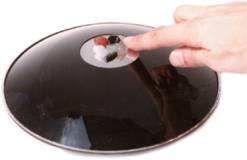
You reach down to try and pick up the toy
animal or car and find that although you can see it the object you will find that you can't touch
it!
Theory and teaching notesWhat you actually see is the image of
the object formed in space by the curved interior of the mirror box. This real image appears
to be sitting on the top of the box.