Toys and Physics - Mechanics
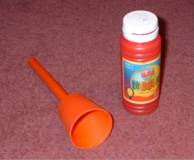
6.8 Soap
bubbles
What happensBubbles can be blown using the special loop
or funnel. They are spherical and show wonderful colours.
Theory and teaching
notesThere is a vast amount of useful physics in soap bubbles.
A large film on
four rods can be made to oscillate like a drum skin showing simple harmonic
motion.
Application areas: surface tension, air pressure, electrostatics, interference,
oscillations
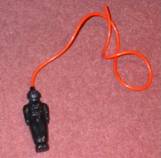
6.9
Cartesian diver
What happensWhen blow into the tube the diver
rises towards the surface. When you suck the diver sinks.
Theory and teaching
notesThis is rather like the principle of the submarine. Blowing into the tube
decreases the average density of the diver and so increases its buoyancy. Sucking the air
out does the reverse.
6.10 Dipping bird
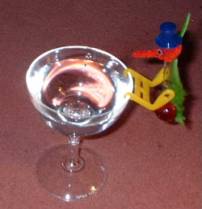 What happens
When the
birds head is wetted by immersing it in the water it sways backwards and forwards, dipping
its head in the water.
Theory and teaching notes.As the liquid inside its
body evaporates it forces liquid up the neck altering the balance of the bird which then dips
its head into the water. Try doing the experiement with alcohol!
If the head is not wetted
then a very instructive version of the experiment occurs. The bird tends not to drink but
placing a saucer of hot water beneath its bottom will heat up the liquid sufficiently increase
the rate of evaporation and make it start rocking. Energy is provided by the hot water – you
don't get something for nothing
6.11 Falling pile of paper
What
happensWhen you drop the paper all the sheets fall together. None of them 'float' to
the ground.
Theory and teaching
notes
6.12 Helium filled
balloon
What happensThe balloon moves in the opposite direction
that you would expect when the car accelerates or brakes. When the car brakes the balloon
moves backwards and when the car accelerates it moves forwards.
Theory and
teaching notes This happens because the average density of helium within the
balloon and the balloon fabric is less than that of the surrounding air.
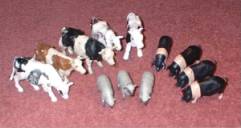
6.13 Dimensional animals
What happensThe set of farm animals can be use to demonstrate the idea of
dimensions and dimensional analysis.
Theory and teaching notesYou
cannot add mass to length or time. The dimensions on either side of an equation must
balance.
6.14 Energy ball
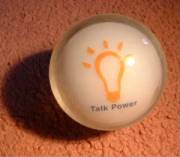 What happens
When you drop the ball onto the floor the
light inside it flashes for a few seconds.
Theory and teaching
notesThe potential energy of the ball is converted to kinetic energy as it falls and
this operates a trigger switch within the ball when it hits the ground.
A useful
demonstration of energy conservation.
6.15 Bouncing ball
bearings
 What
happens
What
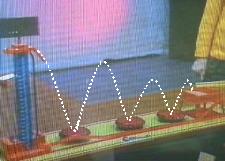
happensThe ball bearings fall from a chute at the top of the tower onto the first of
the rubber trampolines. They bounce off onto the second and then the third trampolines and
then into the collecting box.
Theory and teaching notesThe angle of the
chute and the height from which they fall is just right for the parabolic path of the ball
bearings to hit the trampoline so that the rebound parabola takes them on to the next
trampoline and so on.
I saw this wonderful toy that shows projectile motion being
demonstrated by Jim Jardine at Lancaster University. Unfortunately I believe it is no longer
available but it is well worth trying to make one yourself!
6.16 Slinky
spring
 What
happens
What
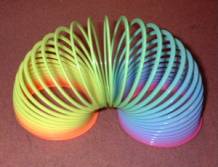
happensThe slinky is held by one end and allowed to dangle vertically. The upper
coils are widely spaced while the lower coils are close together. The question is – what
happens to the lowest coil at the moment the slinky is dropped.
Theory and
teaching notes
6.17 Floating paper tube
 What happens
 You
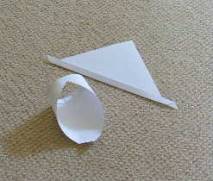
need an isosceles right angled triangle of paper. The long edge is then bent over twice –
each bend being about 0.3 cm wide. This is then bent round in a circle to join the two pointed
ends forming a shape rather like a bishop's mitre. The end is then bent upwards to give he
shape shown in the photograph. If you hold the paper near to the bent up tail and then let it
go it will float across the room covering a distance of many metres.
There are many
possibilities for investigating the range with different types of paper, size of bend and angle
and size of the "tail".
Many thanks to Ian Milne from New Zealand for this
idea.
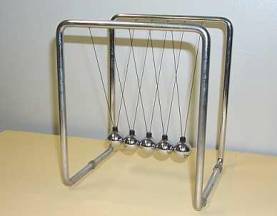
6.18
Newton's cradle
What happens
This is an essential "toy" for any
Physics department. The movement of the static balls after being hit by one or two or even
three others is impressive.
Teaching notesTry investigating what
happens when a small piece of Velcro is stuck to the colliding surfaces of two of the
balls.
A wonderful example of the conservation of momentum in elastic and inelastic
collisions.
6.19 Smiley pop ups and projectile motion
In his book
'Experiments in Physics' Colin Siddons suggested these of small 'pop-up' toys to study
projectile motion. The toys, called Smiley Pop Ups, are very cheap (about 35p in 2005) and
introduce a little bit of fun into the experiment.
You squash the toy onto the bench
and then the rubber sucker slowly comes off and the toy launches itself into the air.
Theory and teaching notesSince the same spring is used each time
the launching force should be the same. This means that both vertical motion and motion at
an angle to the vertical can be investigated. For the angles motion I have used tilted runways
or even tilted the lab tables where this has been possible.
Fix a pin through a piece
of sellotape stuck to the ramp on put a piece of rough paper on the slope will stop the toys
slipping down the slope.
These toys can form the basis of an investigation at GCSE
or A level.