Toys and Physics - Sound and music
7.9 Musical box
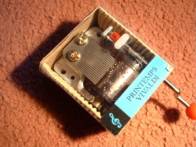 What happens
When you turn the handle the box plays a
tune.
You must turn the handle at the correct speed to hear the tune
properly.
Theory and teaching notesThere are many tiny projections
on the cylinder which catch on a number of metal strips. Each strip is a slightly different
length and when it is twanged it vibrates giving a note.
A good example of the
dependence of frequency on the size of the vibrating object.
7.10 Laughing
doll
 What
happens
What
happensThe doll makes a noise when you hit it or catch it.
Theory
and teaching notesThere are a number of pre-recorded noises and each one is
activated at random when the doll is hit.
An example of the conversion of kinetic energy
to electricity and then sound.
7.11 Clanger
 What happens
When you hit the clanger it
makes a noise like the voice of a clanger.
Theory and teaching
notesThe energy of the blow activates the internal circuit starting the pre-recorded
sound.
A further example of the conversion of kinetic energy to electrical energy to
sound.
7.12 Clangers tube (mini)
What
happensWhen you blow through the tube a note is produced. The pitch of the note
depends on the position of the slider within the tube.
Theory and teaching
notesSmall volume of air in the tube give high notes while large volumes give low
note. The further out you pull the slider the lower the note.
7.13 Wooden
recorder
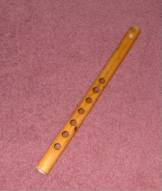 What
happens
What
happensWhen you blow through the tube a note is produced. The more holes
you cover up the lower the pitch.
Theory and teaching notesAs with
the clanger's tube the bigger the volume of vibrating air the lower the pitch of the
note.
7.14 Spinning siren
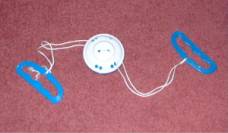 What happens
The siren is first wound up and then when
you pull the strings it spins and gives off a sound.
Theory and teaching
notesWhen you pull on the two ends of the strings the central plastic siren rotates.
Air rushes through holes on the siren and so a sound is made. The faster it spins the higher
the pitch of the note.
A good example of the conversion of kinetic energy to sound and
the dependence of the pitch of the note on the rate of rotation.
7.15 Whistling
water filled bird
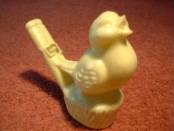 What happens
As you blow into the tube the air is blown
through the water and the bird makes a warbling sound.
Theory and teaching
notes
7.16 Musical rolling ball
What
happensAs the ball rolls a long it chimes.
Theory and teaching
notesThe kinetic energy, both translation and rotation, activates the chimes within
the ball.