

The main purposes of a
telescope used for astronomy are:
(a) to gather as much light as possible – this is done
by using a large aperture lens or mirror. The amount of light gathered depends on the AREA
of the lens – so a lens with an aperture of 300 mm diameter gathers four times a much light
as one with an aperture of 150 mm diameter.
(b) to resolve fine detail – this is also done
by using a large aperture lens or mirror. The larger the aperture the finer the detail that can
be seen. (Usually called the resolving power of the telescope.)
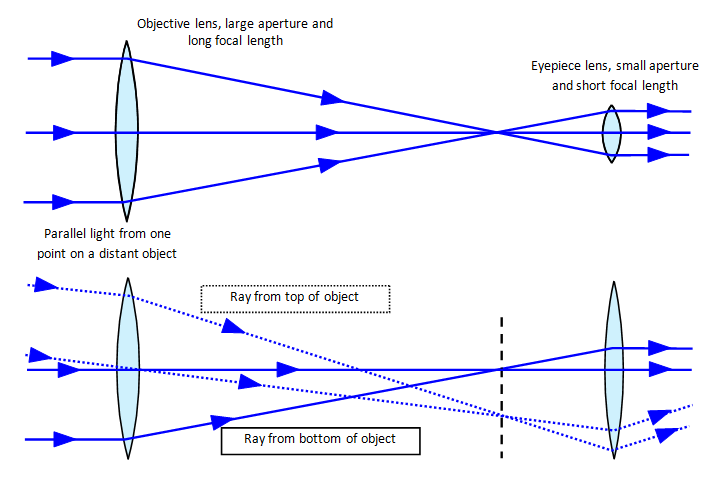
(c) to magnify the image
of a distant object – this is done by using a lens or mirror with a long focal length. The actual
magnification of a telescope can be worked out from the formula:
Magnification =
Focal length of the objective (F)/Focal length of eyepiece lens (f)
(a) the lenses are made of glass and because the light has to go through
them the glass must be perfect – there must be no bubbles of air in the glass
(b) the
lenses can only be supported around their edges and this is where they are thinnest and
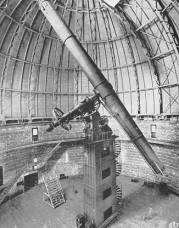
weakest. The largest telescope lens in the world is on of a metre in diameter at Yerkes
Observatory in the USA
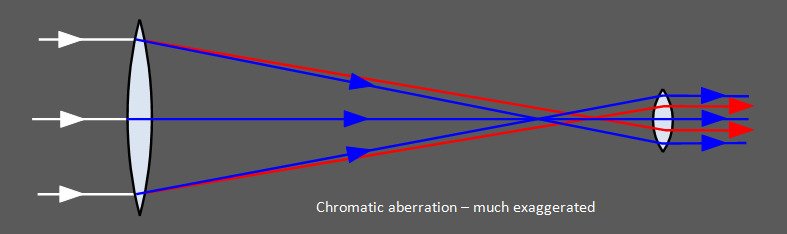
(c) lenses suffer from colour distortion – this means that when
white light passes through the lens it is split into the colours of the spectrum. Because violet
light refracts more than red light it is brought to a focus closer to the lens than the red light –
this makes the image coloured and blurred. This effect is called chromatic aberration.
However for small telescopes
refractors are usually better than refractors because they can be made of high quality glass
with no defects and the colour effects can be eliminated by using special lenses called
chromatic lenses.
Mountings
These are usually of one of two
types:
(a) equatorial where one axis of the mounting is lined up with the axis of the earth.
This type of mounting has the enormous advantage that when you have sighted on a star
you only have to move the telescope about one axis in order to follow it across the
sky.
(b) altazimuth – here the axes are horizontal and vertical. These types of
mountings are used by many very large telescopes as they can be computer controlled to
move to follow the star, but the telescope must continually move on both axes – up or down
and across.
Advantages of a reflecting
telescope:
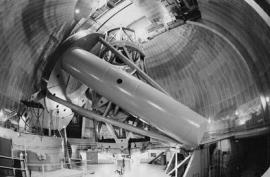
(a) the glass of the mirror does not have to be perfect throughout – only to
have a perfect surface
(b) the mirror can be supported across the whole of its
back
(c) they do not suffer from the colour defects of chromatic aberration
For these
reasons all the really large telescopes in the world today are reflectors. The largest ones
have mirrors up to 10m in diameter.
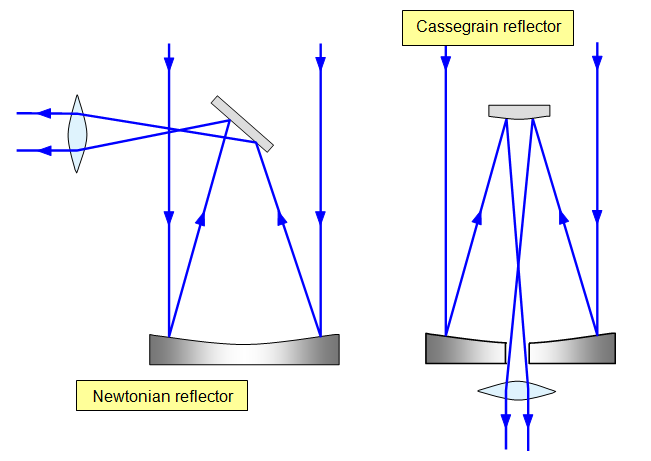
The Newtonian
reflector has an eyepiece at the side of the tube which makes observing
comfortable.
The Cassegrain has an eyepiece below the main mirror which means that
much heavy detection equipment can be fitted here.
The secondary mirrors in the
telescope tubes do not affect the quality of the image – the small amount of light that they
interrupt is negligible compared with the total amount received by the main
mirror.
All mirrors used in astronomical telescopes are silvered on the front surface,
otherwise the light would pass through the glass and both colour distortion and multiple
images would result. The metal used is actually aluminium, vaporised onto the surface of the
glass in a vacuum. It does not reflect quite so well as silver but is better over the complete
range of wavelengths of visible light.
The curvature of the mirrors is usually accurate
to within one eighth of a wavelength of green
light!