

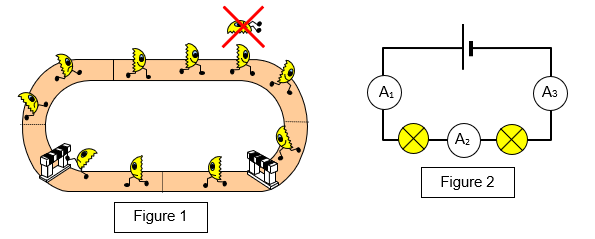
In a circuit no electricity gets lost as it flows round and round. This means
that if we measure the current at different places in a series circuit the AMMETER READING
WILL ALWAYS BE THE SAME. In other words in Figure 2, A1 = A2 = A3. So what is used as the electricity flows - the answer is
ENERGY.
As you may know an electric current is a flow of tiny negative particles called
electrons. The battery gives the electrons energy and this electrical energy is converted to other
forms as they go round the circuit.
Think of the circuit as like a steeplechase. As the
runners (electrons) go round the circuit they loose energy as they go over each barrier (the bulbs).
In the circuit this energy appears as heat and light.
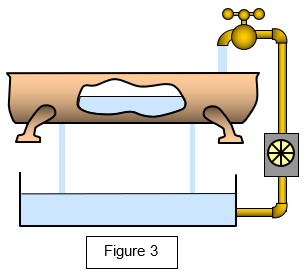
Think of a bath with TWO plug holes like the one
shown in the diagram. The water from the plugholes flows into a tank and then a pump is used to
pump it back up to the tap again. First imagine that ONE plug is taken out and the tap and pump
are turned on to keep the water in the bath at the same level.
Now take the SECOND plug
out. Water now flows out of BOTH holes - but taking the second plug out has no effect on the
water flowing out of the first plughole as long as the level in the bath is kept the same.
The only difference is that the pump will have to work twice as hard as before to maintain
the level. It means that the rate of flow of water from the tap must be TWICE AS GREAT as before
and energy is used by the pump at TWICE THE RATE.
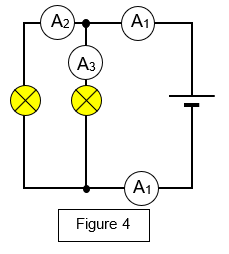
Now compare this with a parallel circuit. The bulbs take the place of the plugholes, switches take the place of the plugs and a battery replaces the pump. You should now see that letting current flow through a second bulb will not affect that flowing through the first. When current flows in both bulbs the current from the battery is TWICE as great as when only one bulb is used and the battery will now RUN DOWN TWICE AS FAST.